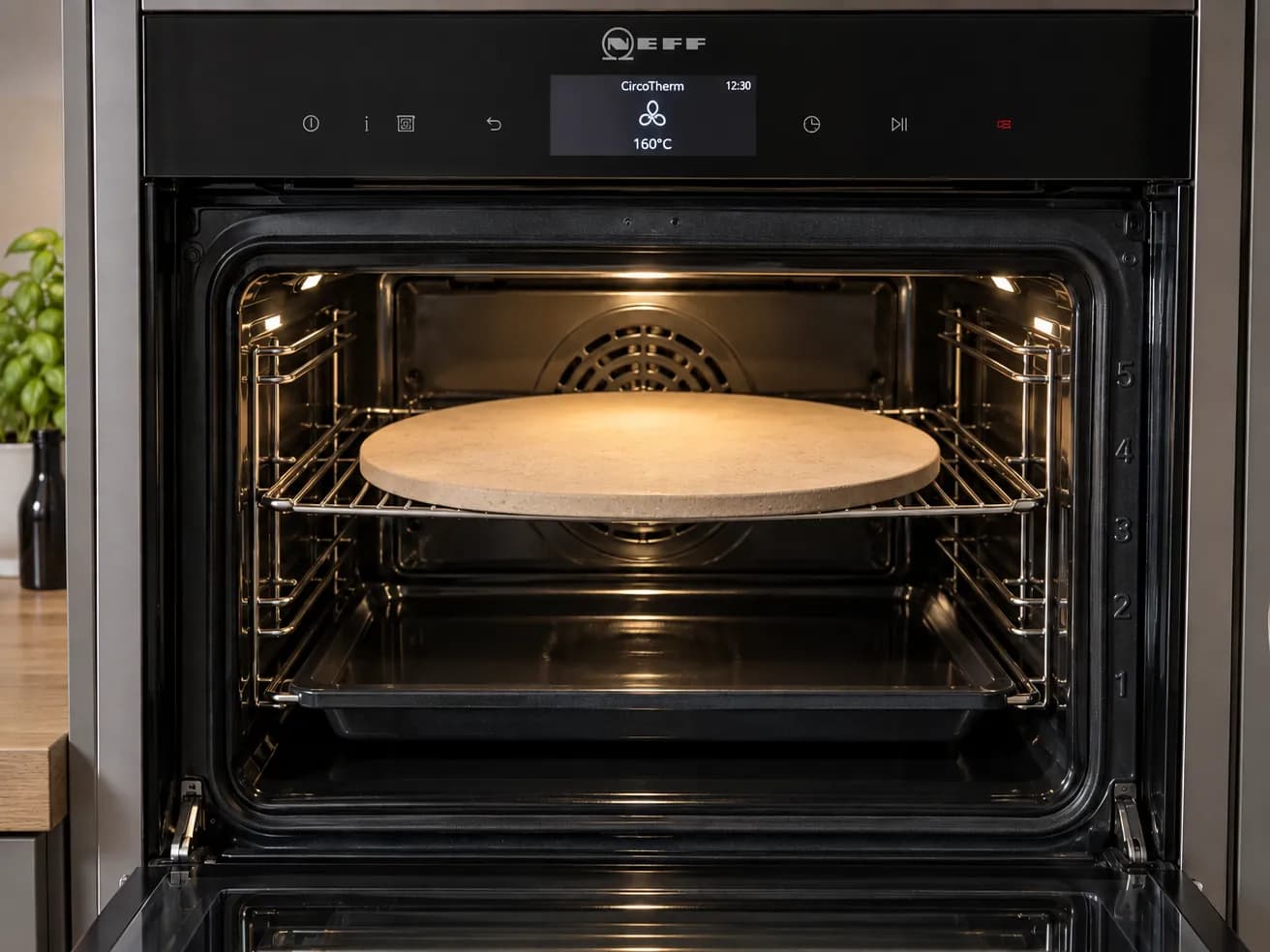
Five years on it still comes out for focaccia and anything else that bakes straight on a surface.
Equipment review
Pizza stone
Unicook round cordierite stone, 30.5cm.
By Steven · Updated September 2026
A round cordierite stone that turns a domestic oven shelf into a hot floor, for about the price of two takeaways.
A great place to start. Buy one before you buy anything expensive, get it hotter than you think it needs, and go square if your oven allows it.
BakeClass Snapshot
- Cost
- Budget
- Longevity
- Long lasting
- Learning curve
- Easy
- Best for
- A crisp base from an ordinary oven.
The cheapest thing here that really changes what comes out.
Do I actually need one?
Yes.Yes if you're baking anything directly on a surface and you're not using an outdoor oven. It's the difference between a base that crisps and a base that sits in its own steam, and it's the least expensive thing that makes that difference, which is why it belongs near the front of any list rather than at the back.
What it does, and why this one
It stores heat and gives it back to whatever you put on it, which is how a base cooks from underneath instead of steaming on a tray. Given a long enough preheat it holds plenty of heat for a base, and it does the same job for any bread that goes straight onto a surface rather than into a tin.
Honestly, no research at all. I bought a stone because a stone was what I knew existed, and only later found out steel was an option. What I can say after five years is that it has never cracked, it has never needed anything doing to it, and I don't feel short-changed by the choice.
Pros and cons
What works
- Cheap enough to be an easy first purchase
- Works for bread as much as for pizza, so it earns its shelf space all year
- No maintenance, no seasoning, no coating to wear off
- Mine hasn't cracked in five years of high-heat use
What does not
- Wants a far longer preheat than seems reasonable, and disappoints if it doesn't get one
- Stains and marks, permanently, from the first few bakes onwards
- Heavy and awkward, and best not moved while hot
- Round, so it wastes oven space a square one would use
What I got wrong
I left it in the oven and forgot about it.
More than once I've turned the oven on to preheat for something else entirely, opened the door, and found the stone sitting there at full temperature taking up a shelf I wanted. Then it's either wait for it to cool or move a very hot slab of ceramic with oven gloves. Neither is a disaster, and both are avoidable.
My experience
Five years or so of both bread and pizza, on a shelf in a domestic oven that reaches about 275C, which is a good oven for the job. For a New York style pizza, a longer bake at a lower heat, it did a genuinely good job. For an authentic Neapolitan it was never in the running, and that's the oven's limit rather than the stone's. It still comes out for focaccia and for anything that bakes straight on a surface, so it never really retired.
Steven, BakeClass
Alternatives
A steel, which is lighter, heats faster and costs more, and which I've never owned. A square stone rather than a round one, which is what I'd buy next time: less about pizza, more about fitting several loaves or rolls on at once.
Will you outgrow it?
Only really if you move to an outdoor oven, and even then it keeps its bread job.