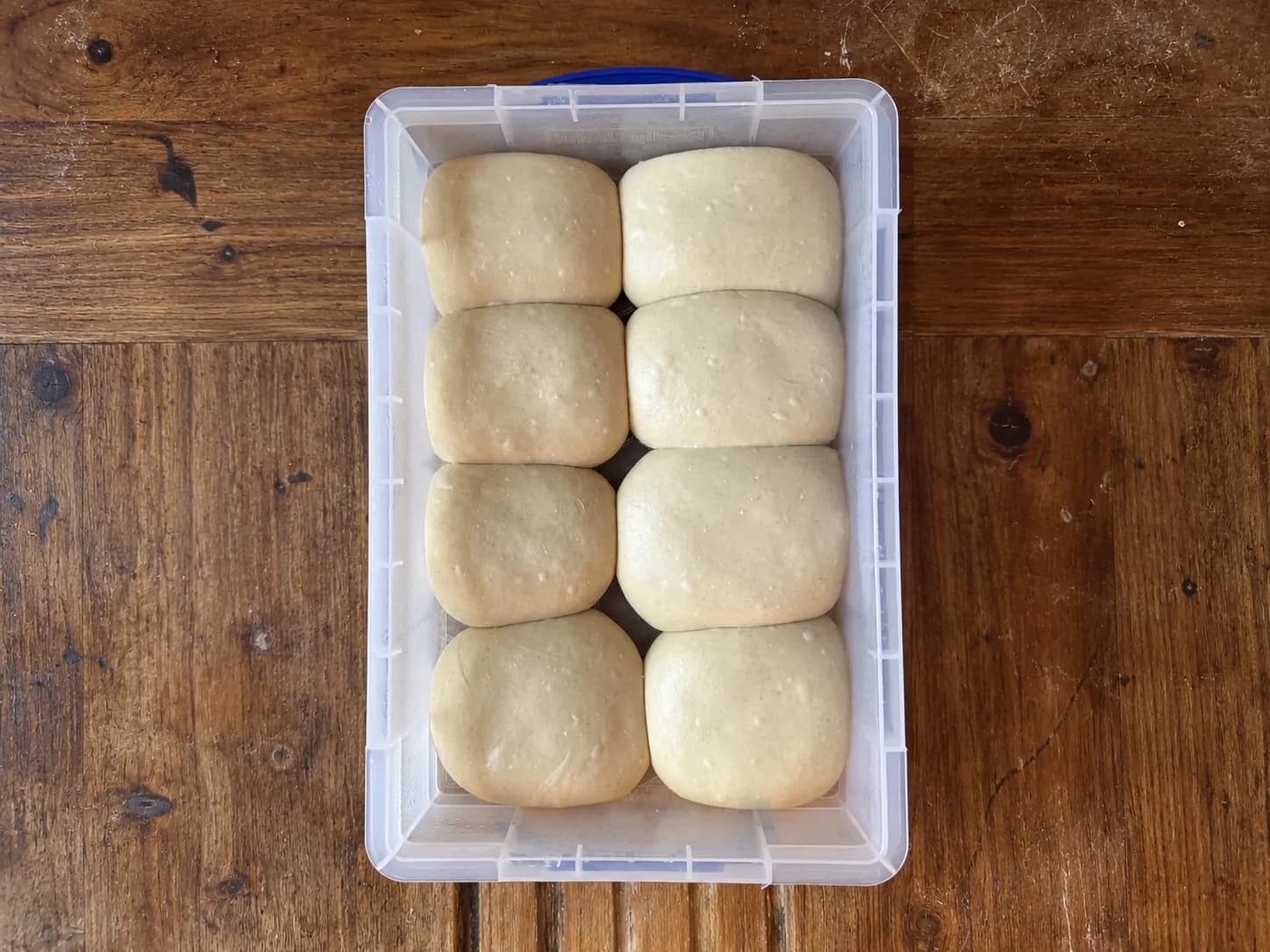
Dough balls that touch come out square, and it takes about twenty seconds to round one off again.
Equipment review
Dough ball box
Plastic storage box sized for A3 paper, with a lid.
By Steven · Updated September 2026
A lidded plastic box made for sheets of paper, doing much the same job as a purpose-made dough tray for a fraction of the money.
Buy the cheapest shallow lidded box that fits your fridge shelf, and put the difference towards something that changes the bake.
BakeClass Snapshot
- Cost
- Budget
- Longevity
- Long lasting
- Learning curve
- Immediate
- Best for
- Cold proving dough balls in a domestic fridge.
A storage box does this job well, and it costs a lot less than the branded version.
Do I actually need one?
Yes.Yes if the dough is proving cold for a day or more, which is where a lot of the flavour in a long-fermented dough comes from. It doesn't have to be this box, though: any shallow lidded container that fits your fridge shelf will do the same thing. What tends not to work well is proving portioned dough in a mixing bowl, because the pieces end up on top of each other and have to be pulled apart later.
What it does, and why this one
It holds portioned dough in a single layer, under a lid, at fridge temperature, for as long as the recipe asks for. That's the whole job. The lid stops the surface drying and skinning, the flat base keeps the pieces in their own space, and because it's shallow it fits a fridge shelf rather than taking one over.
Mostly the arithmetic. The purpose-made trays are moulded with a fixed number of slots, and slots are a limit as much as a feature: six is six, so a bigger batch needs a second tray. A plain box takes one piece or eight, whatever you happen to be making, and it costs what a storage box costs.
Pros and cons
What works
- Takes one piece of dough or eight, so the batch decides, not the container
- Shallow enough to fit a fridge shelf without rearranging the fridge
- Costs what a storage box costs
- Easy to wash, and no coating to look after
What does not
- No moulded slots, so pieces that touch will spread into each other and come out square
- Sold as stationery, so sizes are quoted in paper sizes rather than in anything useful to a baker
- Thin plastic, so it's a box rather than an heirloom
My experience
I couldn't find the order for mine, so it wasn't bought from Amazon and I can't point you at the exact one. That's part of the point: it's an ordinary box. Pieces that touch each other do come out square more often than not, because butting up against a neighbour forces them that way, and for the first few batches it bothered me. It stopped bothering me once I could handle the dough well enough to bring a square piece back round, which takes very little skill and about twenty seconds.
Steven, BakeClass
Alternatives
The obvious alternative is a purpose-made proving tray, and the Gozney one is the one I looked at hardest, because most of my kit is Gozney and it looks the part. Its moulded slots are a genuine help when you're starting out: nothing sticks to anything else and every piece keeps a clean round shape. What put me off was the cost against the capacity, and the fact that the tray is large enough that six pieces take up a lot of fridge. If you have the money and you like the brand, it's a nice thing to own. I'd rather spend it on flour.
Will you outgrow it?
Probably only by making more dough than a fridge shelf holds, and then the answer is another box rather than a better one.