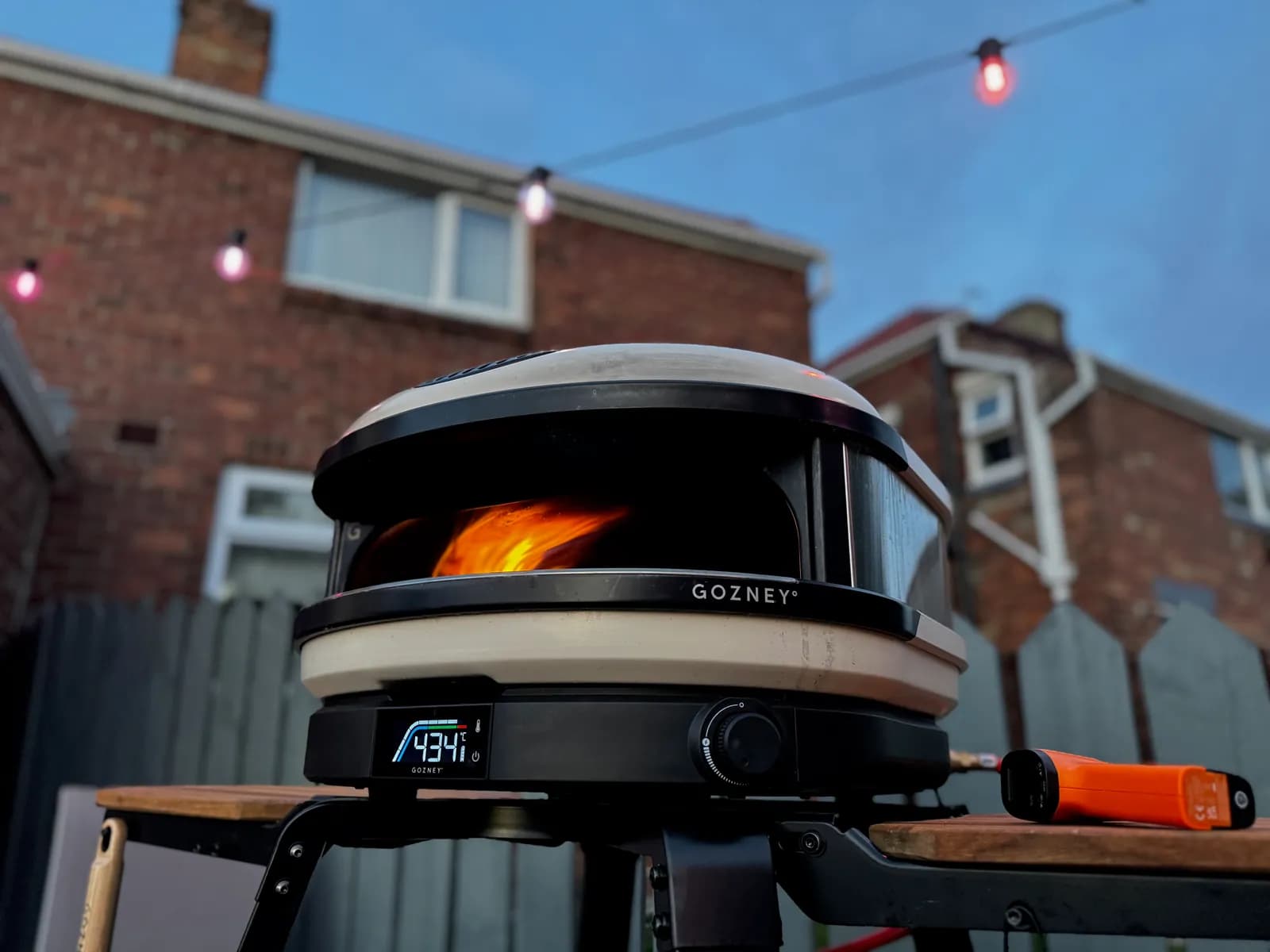
Being able to wheel it somewhere sheltered and lock it there saves the whole preheat.
Just over a year old, and it lives outside under a cover.
Equipment review
Arc XL pizza oven
Gozney Arc XL in Bone, gas only. Larger cooking surface than the standard Arc; own stand and cover available.
By Steven · Updated September 2026
A gas-fired outdoor oven that reaches temperatures a kitchen oven can't, and bakes a base in around ninety seconds.
A brilliant thing to own once pizza is a habit. Buy it then, rather than to find out whether it will be.
BakeClass Snapshot
- Cost
- Premium
- Longevity
- Buy once
- Learning curve
- Takes practice
- Best for
- A bake measured in seconds rather than minutes.
It does something no domestic oven does, and it asks for an hour and some outdoor space in return.
Do I actually need one?
Probably.Probably not, and I'd rather say so. For anything baked at ordinary oven temperatures a stone on a shelf does the job, and that's what I used for years. This is for one specific thing: the very fast, very hot bake, and the pizza that comes with it. If that's not what you're chasing, the money goes further elsewhere.
What it does, and why this one
It gets a stone floor and the air above it far hotter than a domestic oven manages, and holds them there. That combination is what cooks a thin base in a minute and a half, and gives the top the colour and spotting a longer, cooler bake never quite produces.
I wanted a bigger floor than the standard model without going to the full-size one, and I wanted something with a stand of its own, which ruled out the sit-on-a-worktop options. Gas rather than wood was deliberate: wood means keeping fuel in, cleaning the thing out afterwards, and learning to manage a fire on top of learning to manage the bake, and from what I read the flavour difference is smaller than the extra work. What matters most is that it gets hot and stays hot.
Pros and cons
What works
- Reaches and holds a temperature no domestic oven gets near
- Bakes in around ninety seconds, so a batch goes through quickly
- Gas means no fuel to store, no ash, and one variable fewer to manage
- On its stand it sits at a height you can actually watch the bake from
What does not
- There's no door, so it loses heat faster than if it were an enclosed oven. That's what the thirty or forty minute preheat is really about, and it's most of an hour you have to plan around
- An open flame marks the paintwork round the mouth, and on the Bone finish you can see it - you can clean it off, but it does require effort to do so
What I got wrong
I didn't let the deck saturate.
The mistake most people make, myself included, is judging readiness by how quickly the oven says it's hot rather than by whether the floor has taken the heat all the way through. That can take thirty to forty minutes. Launch before it has and the top runs ahead of the base: colour and spotting above, a pale and floppy underside, and it looks like a dough problem.
My experience
Just over a year, used most months through the summer and now and again when the weather turns. It has held up very well, helped by keeping it covered. Sooty marks do appear around the mouth, on the cream, which is what an open flame does. I've cleaned them off every time and it has looked as good as new afterwards, so treat them as a job rather than as damage.
The cover is the most heavy-duty one I've come across, a good deal sturdier than the one on my Weber barbecue and about the same money. I'd use a cover whatever the specification said, given what the oven cost, but this one is worth the money on its own.
The stand it sits on has wheels that lock, which matters more than it sounds: an oven warming up for the better part of an hour is at the mercy of the breeze, and being able to roll it to a sheltered corner and lock it there is the difference between a preheat and a relight. The stand's folding side tables are soft wood and the grain lifted after a while outdoors, so I sanded them back and re-oiled them, and they look new again.
So far it has only cooked pizza, though people online cook in cast iron in them and I intend to try it.
Steven, BakeClass
Alternatives
A stone or steel in a domestic oven, which is the honest alternative for most people and what I used for about five years. A wood-fired version, if the fire is part of the appeal rather than a chore. A smaller portable oven, which costs less and takes smaller pizzas.
Will you outgrow it?
Unlikely. The thing that would push you past it is wanting to cook several pizzas at once, which is a different class of oven again.