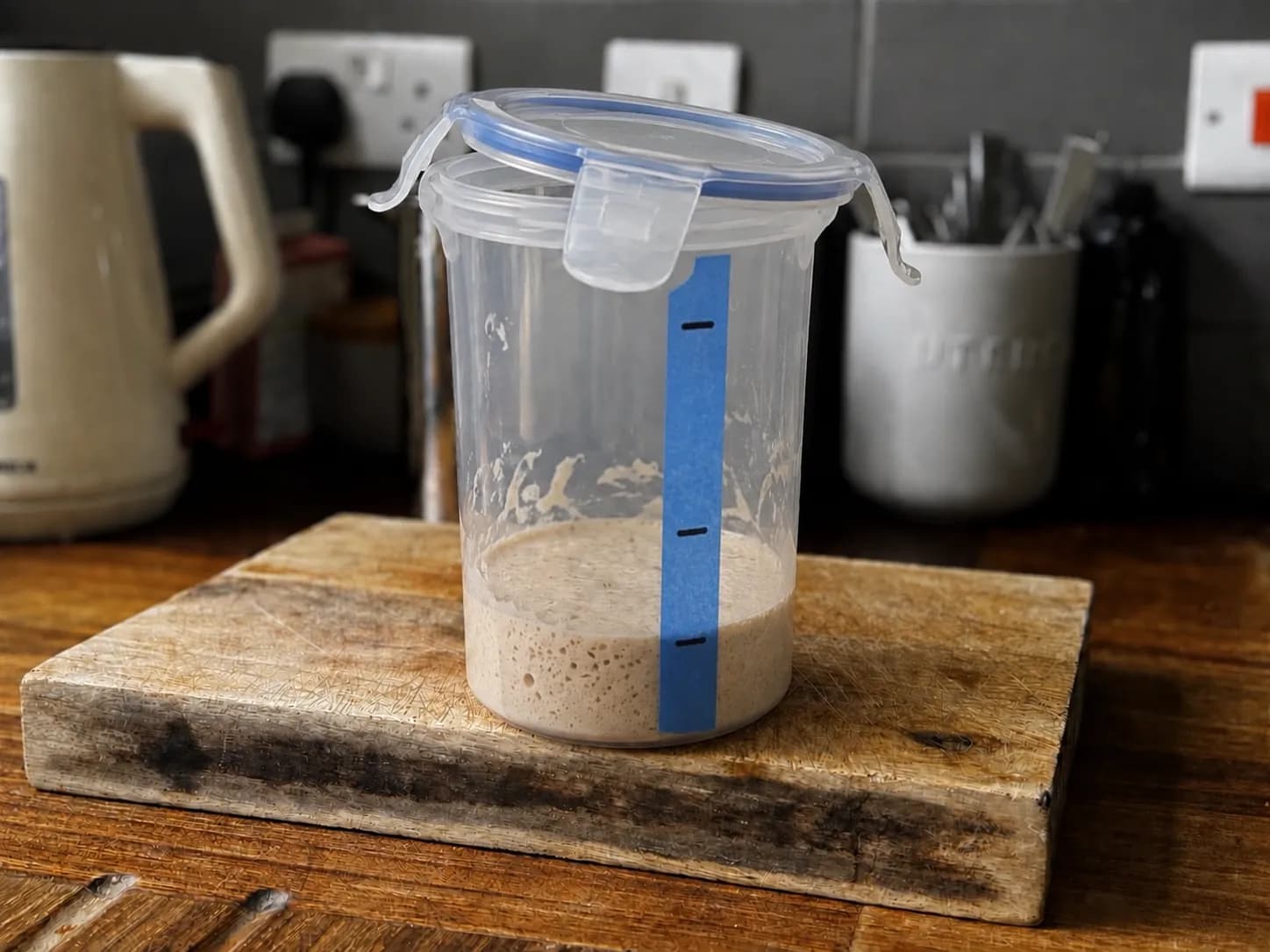
Masking tape up the side, two lines.
At least three years of use
Equipment review
Clear round starter tub
Any tub · clear, round, straight-sided · taller than you think you need
By Steven · Updated September 2026
Clear sides show the one thing you actually need to see: how far the starter has risen.
Get it clear, round and much taller than the starter, and it is the last starter container you will buy.
BakeClass Snapshot
- Cost
- Budget
- Longevity
- Long lasting
- Learning curve
- Immediate
- Best for
- Anyone keeping a starter
Clear, round, taller than you think you need. Rest the lid on rather than clipping it shut.
Do I actually need one?
Yes.You need somewhere to keep your starter, and it should be clear, round and considerably bigger than the starter itself. There is a healthy trade in ceramic sourdough crocks and branded starter jars, and they are pleasant objects, but an opaque crock hides the one thing you actually need to see - how far the starter has risen since you fed it. That is how you know it is ready. Buy a clear plastic tub and put the difference towards flour.
What it does, and why this one
Holds the starter between feeds, lets you watch it rise, and goes in the fridge when you need to slow it down. The rise is the reading you take before every bake - a starter that has doubled and is holding is ready, one that has risen and collapsed has peaked and gone past it.
Round, clear, straight-sided and much taller than the starter needs. Round matters more than it sounds: a square container has corners, and corners hold starter that a spatula cannot reach cleanly, which makes both feeding and washing up more work than they need to be. Tall matters because a lively starter can climb further than you expect, and the difference between plenty of headroom and not quite enough is the difference between a rise and a mess on the worktop. I found 700ml is the sweet spot for a modest starter - big enough for the climb, small enough to fit on a fridge shelf.
Pros and cons
What works
- Clear sides, so you can read the rise at a glance
- Round profile empties and cleans easily with a spatula
- Enough headroom for a lively starter to climb
- Fits a fridge shelf when you need to slow things down
- Costs very little
What does not
- The airtight seal is the one feature you mostly cannot use
- Clamp it shut on an active starter and pressure builds
- Resting the lid on instead makes the locking clips redundant
What I got wrong
A square container first
I replaced it purely because of the corners. Getting the starter out cleanly and then washing it up afterwards was more of a job than it should have been.
My experience
I have used a tub like this for at least three years. Before it I had a square container, and I replaced it purely because of the corners - getting the starter out cleanly and then washing it up afterwards was more of a job than it should have been. With a round tub and an ordinary silicone spatula it takes seconds. I keep about 150ml of starter, which barely covers the base and comes maybe a centimetre up the side, and all the rest of that 700ml is headroom for the climb. I run masking tape up the outside with marker pen on it: one line where the starter sits after feeding, another where I know it needs to reach before it is ready. When I am away I seal the lid properly after a final feed and put it in the fridge, and it has sat there for two or three weeks or more, quite happily. It takes a couple of feeds to come back to full strength, and then I am straight back to baking.
Steven, BakeClass
Alternatives
A large Kilner-style jar works, but the shoulder curves in at the top which makes the rise harder to read and the last of the starter harder to reach. Avoid square containers for the same reason. A ceramic crock looks lovely but hides everything you need to see.
Will you outgrow it?
Only if you decide to keep a much larger starter. The tub itself will outlast several starters.